

Table of contents
Introduction
Le monde que soutiennent les assureurs évolue rapidement. Les infrastructures et les projets de construction à très grande échelle se multiplient à un rythme record. Les campus de centres de données, les complexes d'entrepôts, les pôles logistiques et les corridors d'énergie renouvelable sont en pleine expansion.
Le marché mondial de la construction de centres de données était évalué à 245 milliards de dollars US en 2024 et devrait atteindre 371 milliards de dollars US d'ici 2030, avec un taux de croissance annuel composé (TCAC) de 7,2 %.
BusinessWire
Ces projets exigent ce que les assureurs ont rarement eu : une visibilité claire sur les conditions du site et la capacité de surveiller ce qui cause les retards. Sans cela, les souscripteurs peinent à évaluer la véritable exposition financière de chaque projet. Les conséquences se manifestent sous forme de réclamations pour retard de mise en service (DSU), souvent l'exposition la plus importante d'une police, et de litiges en responsabilité civile de construction qui peuvent s'étirer sur des années. Il s'agit de certaines des pertes les plus lourdes que les assureurs doivent absorber.
Pourtant, on demande aux assureurs de souscrire à la complexité de demain avec les connaissances et les outils d'hier. L'écart entre ce qui est construit et ce qui peut être évalué avec confiance ne cesse de se creuser.
Les flux de travail en assurance ont besoin d'une mise à niveau
Lorsqu'une soumission pour de tels projets de construction à très grande échelle est reçue, le processus de souscription semble simple sur papier :
- Le courtier envoie les documents.
- Le souscripteur examine le dossier.
- Un ingénieur en risques analyse les documents techniques.
- Des informations supplémentaires sont demandées.
- Un consultant interprète les preuves.
- Tout revient à la case départ pour la tarification finale et les conditions.
Mais en pratique, c'est complexe. Les souscripteurs commencent avec des informations partielles. Les ingénieurs en risques reçoivent des rapports denses et des documents non structurés sans résumé clair des risques du site. Cela justifie les visites physiques sur place. Et une fois sur le terrain, le processus devient logistiquement compliqué et chronophage. Les consultants fournissent des interprétations ponctuelles basées sur des preuves limitées, mais peu de rapports sur l'évolution de la situation tout au long du projet.
Tout au long de ce cycle, les risques liés aux conditions du site demeurent incohérents ou dispersés.
La pression est amplifiée par l'ajout rapide de projets au portefeuille, alors que les chantiers de construction se multiplient plus vite que jamais. Un ingénieur peut examiner des dizaines de sites complexes chaque semaine, laissant peu de place à une analyse approfondie.
Parallèlement, la variabilité climatique modifie les régimes des eaux souterraines, intensifie les cycles de retrait-gonflement et altère le comportement des sols mous, des phénomènes que les rapports statiques ne peuvent saisir. Le secteur de l'assurance est confronté à davantage de conditions de site, d'instabilité des sols et de pertes liées aux retards, avec une capacité réduite à les évaluer. Voici les répercussions pour les assureurs :
- Le triage ralentit lorsque les soumissions sont désorganisées
- Souscription incohérente due à des interprétations divergentes
- Les examens techniques deviennent coûteux ou répétitifs
- Les expositions sont acceptées sans visibilité complète
- Décisions difficiles : ce qui est couvert et ce qui ne l'est pas
- Litiges concernant les « conditions de site imprévues ».
Le besoin est clair pour toutes les parties. Les assureurs veulent de la rapidité. Les ingénieurs veulent de la précision. La conformité exige de la traçabilité. Les flux de travail traditionnels imposent des compromis entre ces trois impératifs.
Modèles de pertes dans les projets d'infrastructure pour les assureurs
Responsabilité civile en construction
Lorsque des défaillances liées au sol surviennent des années après la fin des travaux (problèmes de drainage, mouvements structurels ou de fondation), la question centrale devient : le problème existait-il déjà ou est-il apparu plus tard ? Sans preuve du comportement du site avant la souscription, les assureurs sont contraints de gérer ces litiges par un processus lent, coûteux et souvent non concluant.
« Il peut falloir des années pour déterminer si la police était rentable. »
Assurance contre les retards de mise en service (DSU)
Pour que la perte d'un propriétaire soit couverte par une assurance DSU, le retard doit être directement causé par des dommages matériels (glissement de terrain, incendie, défaillance structurelle ou autres événements assurés). Les retards découlant d'autres causes (grèves, problèmes de chaîne d'approvisionnement, mauvaise gestion ou conditions préexistantes) sont, dans la plupart des cas, exclus ou bénéficient d'une couverture limitée.
Cela crée toutefois un défi fondamental : assurer un suivi constant de l'avancement tout au long de la construction, afin que les assureurs puissent distinguer les retards couverts des retards non couverts au besoin. Cette tâche est généralement confiée à un expert en sinistres spécialisé ou à plusieurs consultants en ingénierie légale.
Le processus semble efficace en théorie, mais lorsque les réclamations surviennent, la donne change complètement. L'analyse rétrospective de l'avancement après un incident assuré est longue, coûteuse et nécessite de croiser différentes sources de données, des rapports et, surtout, de procéder à des vérifications croisées. Tout repose sur l'identification de la cause exacte ayant déclenché l'événement, car un dommage matériel assuré relativement mineur peut entraîner des centaines de millions de dollars en réclamations DSU.
Le moteur caché des ordres de modification et des retards : l'instabilité des sols
Derrière de nombreux ordres de modification et retards de construction se cachent les conditions du sol : Mouvement des fondations, défaillance du drainage, erreur de nivellement, soulèvement par les eaux souterraines, remblai non documenté et déformation à long terme.

Il ne s'agit pas de cas isolés, mais de tendances récurrentes dans les centres de données, les parcs logistiques, les corridors énergétiques et les infrastructures publiques. Le défi réside dans le fait que les preuves nécessaires pour les comprendre ne sont jamais présentées sous une forme exploitable par les assureurs. Trois raisons principales expliquent pourquoi ces preuves cruciales passent inaperçues :
1. Données éparses et ponctuelles
Chaque soumission repose sur une poignée de forages et un rapport géotechnique. Bien que précis aux points de forage, ces derniers ne permettent pas de saisir l'évolution de la capacité portante à 20 ou 30 mètres de distance, les mouvements saisonniers des eaux souterraines ou la présence de remblais non documentés. Deux souscripteurs analysant des rapports géotechniques pour des sites similaires peuvent aboutir à des interprétations totalement divergentes. Les décisions finissent par reposer sur l'intuition professionnelle plutôt que sur une visibilité spatiale réelle.
2. Preuves fragmentées sans norme commune
L'information est dispersée entre diverses sources : journaux de forage, plans de nivellement, dessins CAO, notes d'inspection, photos par drone, résultats d'analyses de sol et rapports PDF de 150 à 300 pages. Rien n'est harmonisé, rien n'est intégré dans un flux de travail unifié. Les ingénieurs en risques doivent consacrer un temps considérable à reconstituer les faits de base sur la nature du site, son évolution et ce qui pourrait se cacher sous la surface.
3. Absence d'historique pluriannuel du comportement du sol
C'est peut-être la lacune la plus importante : les assureurs voient rarement comment le sol se comporte réellement au fil du temps. Il n'existe aucun registre de déformation pluriannuel, aucun historique des modifications du terrain, aucune visibilité sur les cycles de recharge des nappes phréatiques, ni aucune capacité à comparer les conditions avant et après un événement.
Ces trois lacunes obligent les ingénieurs en risques et les souscripteurs à prendre des décisions basées sur des informations partielles ou extrêmement fragmentées. Les coûts réels ne se manifestent que des années plus tard, sous forme de retards de construction, de défaillances post-construction et de réclamations à long terme.
Les outils actuels ne résolvent qu'une partie du problème
Le problème n'est pas le manque de données, mais l'absence d'une couche de preuve unique et vérifiable qui centralise tout : la précision des journaux de forage, les informations enfouies dans les documents soumis, la corrélation avec les déformations du sol à grande échelle, les conditions du site à travers les phases du projet, les risques liés à l'eau et les changements historiques.
Présentation des playbooks TRAIL pour les flux de travail en assurance
Qu'est-ce que TRAIL pour l'assurance ?
TRAIL est un assistant IA pour les assureurs. C'est un agent qui lit tous les rapports denses et les documents non structurés, interprète les cartes de mouvement du sol dérivées de données satellites, croise les couches de risques multiples et assemble le tout dans un dossier prêt pour la souscription, avec un raisonnement clair et traçable.
Il permet à l'équipe de souscription d'économiser des jours de recherche documentaire. Il permet à l'équipe des réclamations d'évaluer les conditions du site sans avoir à effectuer d'inspections sur place pour vérifier les demandes.
Grâce aux playbooks TRAIL, ils peuvent identifier les signaux critiques pour une analyse prête pour l'assurance.
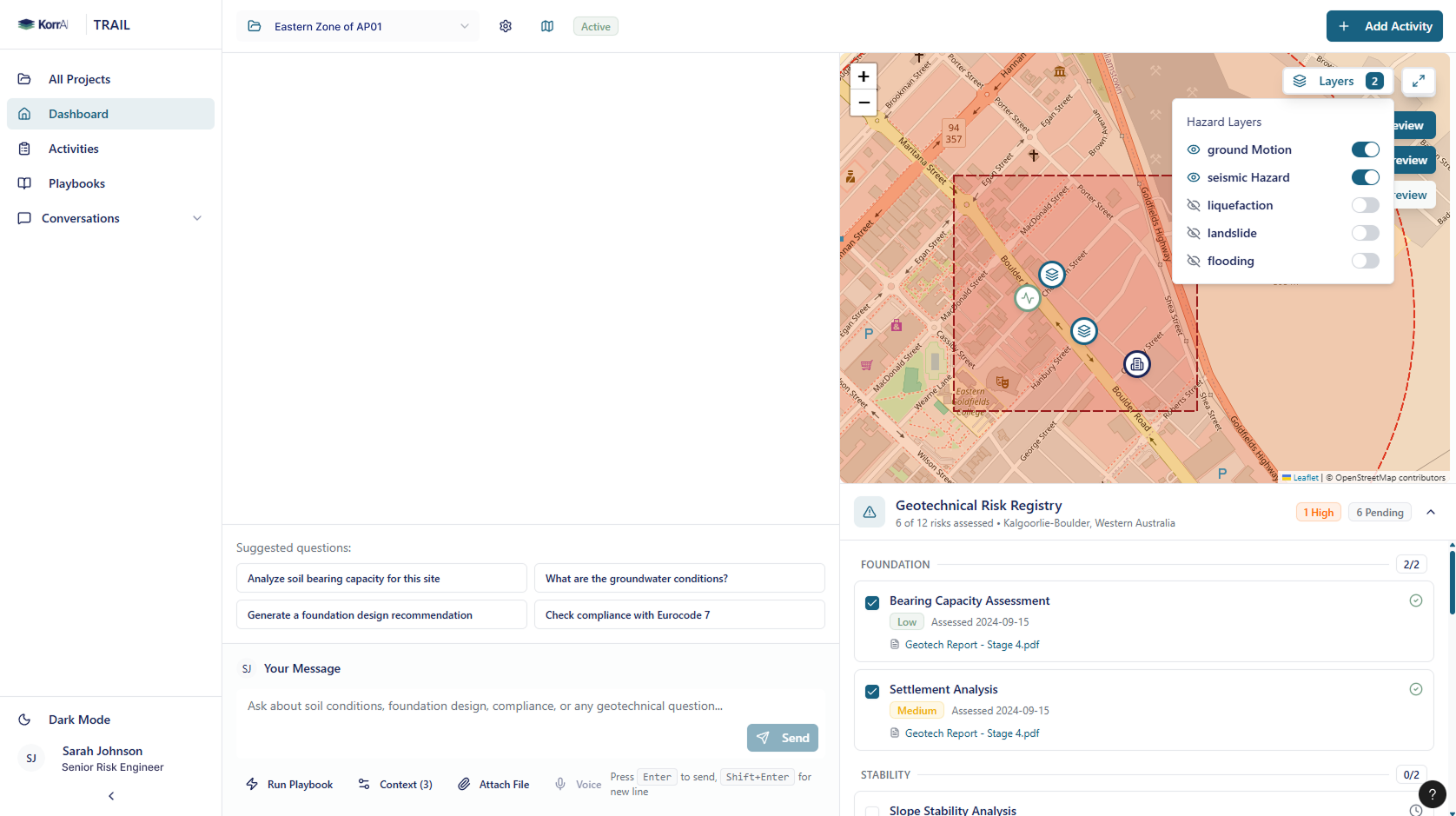
Découvrez comment TRAIL offre aux assureurs la visibilité qui leur manquait : TRAIL - Travailleurs IA pour l'assurance construction
Que sont les guides de stratégies TRAIL?
Les guides de stratégies sont des flux de travail normalisés au sein de TRAIL qui évaluent différents aspects du risque. Chaque guide repose sur des preuves géospatiales mesurées sur plusieurs années, fournies sous forme de résumés étayés par des sources, de catégories de risque et de cartes qui appuient directement la souscription, les recommandations techniques et l'analyse des réclamations.
{{services-widget}}
Comment les guides de stratégies soutiennent l'assurance construction
Les guides de stratégies TRAIL renforcent les flux de travail d'assurance existants. Pour la responsabilité civile en construction et les grands projets d'infrastructure, ils fournissent aux souscripteurs, aux ingénieurs en risques et aux équipes de réclamations une couche de preuves unique et cohérente sur laquelle ils peuvent s'appuyer, de la première soumission jusqu'à l'analyse après sinistre.
Souscription et recommandations techniques
Les guides de stratégies offrent aux souscripteurs et aux ingénieurs en risques une vue claire et consolidée de la stabilité du sol, de l'historique du nivellement et des sensibilités liées à l'eau autour d'un projet proposé. Au lieu de parcourir des documents dispersés ou de se fier à des forages isolés, l'équipe visualise :
- les tendances de stabilité cartographiées
- les zones de variabilité du sous-sol
- les zones d'accumulation ou de recharge liées à l'eau
- les parties du site façonnées par des travaux de terrassement antérieurs
Cela aide à affiner les décisions initiales : quand demander plus d'informations, quand appliquer des conditions et quand escalader pour une révision technique. Plus important encore, cela fournit une justification traçable pour ces décisions, fondée sur des preuves mesurables plutôt que sur le seul jugement.
Audit des réclamations et ingénierie forensique
Lorsque des litiges liés au sol surviennent des années après la construction — tassement, soulèvement, défaillances de drainage ou impact sur le voisinage — les guides de stratégies aident à reconstituer l'état du site avant, pendant et après le projet.
Cela comprend :
- Les déformations préexistantes et les risques liés à l'eau
- La façon dont les travaux de terrassement ou de nivellement ont modifié le terrain
- Si les schémas de mouvement se sont accélérés après la construction
- Quelles conditions étaient prévisibles au moment de la souscription
La capacité de comparer le comportement du sol avant et après un événement offre aux équipes de réclamation une base de preuve neutre pour déterminer si la perte découle de conditions préexistantes, d'activités de construction ou de facteurs externes. Cela permet d'abréger les litiges, de clarifier les responsabilités et d'appuyer des résultats plus défendables.
Évaluation du retard de démarrage
Grâce à l'imagerie satellite haute résolution de tiers et à l'analyse des changements de KorrAi, TRAIL permet de surveiller l'avancement tout au long de la construction. Avec des preuves vérifiables de l'état du projet, les assureurs peuvent répondre à des questions telles que :
- Les conditions du site ont-elles réellement retardé la construction et les opérations commerciales ?
- Quelle part du retard total est attribuable à l'événement assuré par rapport à d'autres facteurs ?
- Quel était l'état du projet immédiatement avant que l'événement ne soit signalé ?
- Existait-il des raisons préexistantes aux retards qui devraient être exclues de la réclamation ?
Étude de cas : Comment KorrAI aide la souscription en responsabilité civile construction de Zurich
Contexte
Zurich E&S fournit un exemple concret de la façon dont l'intelligence géospatiale à distance transforme déjà la souscription. Dans le domaine de la responsabilité civile construction, Zurich utilise opérationnellement l'indice de risque de mouvement du sol (GMRI) de KorrAI dans le cadre de son flux de travail d'enrichissement des risques. Bien que l'affaissement soit exclu des polices de biens en tant que mouvement de terrain, il demeure une exposition importante en responsabilité civile pour les entrepreneurs, les entreprises de conception-construction et les ingénieurs.
C'est là que la visibilité avant la souscription a longtemps fait défaut.
Solution
Pour combler cette lacune, Zurich intègre le GMRI directement dans son pipeline d'enrichissement de la déclaration des valeurs (SOV). Le GMRI est ajouté pour huit États à haut risque où il a été démontré que les mouvements de terrain influencent considérablement les résultats en matière de responsabilité.
Cet ensemble de preuves élargi alimente le score de qualité du risque de responsabilité civile de Zurich, qui oriente les processus d'escalade. Le GMRI devient ainsi un élément structurel du processus décisionnel : un moyen d'identifier rapidement les sites présentant une instabilité de terrain élevée et de garantir que les recommandations et les conditions sont fondées sur des risques mesurables plutôt que sur des interprétations anecdotiques.
Impact
L'intégration du GMRI dans le flux de travail de Zurich a servi de preuve cohérente pour la souscription de l'assurance responsabilité civile construction. Le déploiement par Zurich valide le GMRI en tant qu'outil opérationnel, évolutif et de qualité assureur.
Grâce aux « Playbooks » de TRAIL, les assureurs peuvent passer d'un signal unique puissant à une couche de preuves entièrement structurée pour offrir une souscription cohérente, documentée et défendable.
Réflexions finales
Le risque lié au sous-sol a toujours existé; ce qui manquait, c'était un moyen fiable de le détecter tôt, avec précision et à l'échelle exigée par le secteur de l'assurance. Le GMRI a prouvé que des données pluriannuelles sur les mouvements de terrain peuvent renforcer de manière significative les décisions en matière de responsabilité civile construction. TRAIL et ses « Playbooks » s'appuient sur cette base pour intégrer l'intelligence documentaire, l'évolution des sites, le comportement des eaux souterraines et le contexte des risques dans un flux de travail traçable.
Pour les assureurs confrontés à la croissance rapide de la construction et à l'augmentation des pertes liées au sol, cela représente une voie pratique à suivre : une meilleure visibilité, des décisions plus cohérentes et un meilleur contrôle de l'exposition à long terme.
Si vous souhaitez découvrir comment TRAIL peut soutenir vos programmes de souscription et d'ingénierie des risques, vous pouvez soumettre une déclaration d'intérêt pour TRAIL ou réserver une rencontre avec nos experts pour en savoir plus.
Share this post


Written By
.png)

Rahul Anand
PDG et cofondateur
Rahul est PDG et cofondateur de KorrAI. Entrepreneur en série, il a déjà bâti des entreprises prospères dans les secteurs de l'Internet grand public et de l'IoT. Il vise maintenant à lutter contre l'affaissement du sol, qui devrait toucher plus de 25 % de la population mondiale au cours des prochaines décennies.

Rob McEwan
CPO et cofondateur
Rob dirige le développement de produits chez KorrAI, se spécialisant dans l'InSAR, la télédétection et l'analyse géospatiale pilotée par l'AI. Avec une formation en géologie et en science des données, il a travaillé dans les domaines de l'exploration, de l'exploitation minière et de l'analyse basée sur le SIG. Passionné par la technologie et la créativité, il aime la photographie infrarouge, la musique et les projets pratiques en menuiserie et en automatisation.
Written By

Team KorrAI

.png)

Risque de Mouvement du Sol

Risque de Pieux

Risque d'Eau et de Drainage

Évolution du Site

Intelligence Documentaire
Abonnez-vous à notre infolettre
Nous envoyons à l'occasion des courriels contenant des mises à jour, nos derniers blogues et nos lectures préférées sur InSAR et le paysage lent de l'affaissement du sol.
Lu par les meilleurs professionnels sur
.webp)


Oups ! Quelque chose s'est mal passé lors de la soumission du formulaire.
.webp)


.svg)
.svg)
.svg)
2026 KorrAI. Tous droits réservés.
L'IA traçable pour des projets de plusieurs milliards de dollars.
Abonnez-vous à notre infolettre
Nous envoyons à l'occasion des courriels contenant des mises à jour, nos derniers blogues et nos lectures préférées sur InSAR et le paysage lent de l'affaissement du sol.
Lu par les meilleurs professionnels sur
Oups ! Quelque chose s'est mal passé lors de la soumission du formulaire.