.png)
Table of contents
Introduction
Tout plan de construction commence par des certitudes, jusqu'à ce que le terrain en décide autrement.
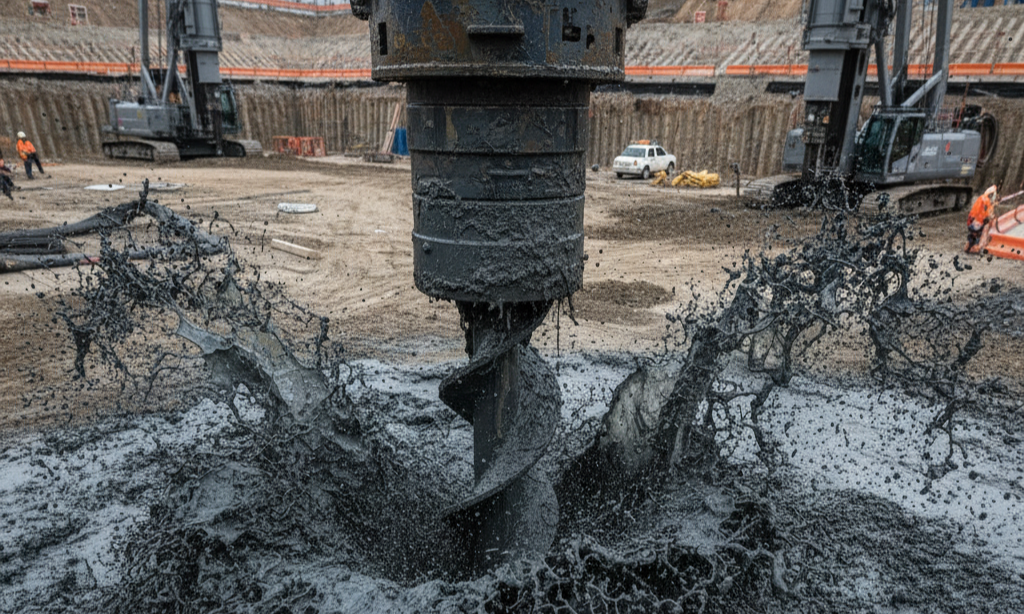
Sur un chantier de centre de données à grande échelle dans le Midwest américain, les rapports de forage racontaient une histoire simple : un sol uniforme, aucun signal d'alarme. Puis, le forage a commencé. Les appareils ont atteint la nappe phréatique à 12 pieds, bien au-dessus du niveau prévu. Les excavations ont été inondées, les pompes ont tourné sans arrêt et les ingénieurs ont dû décider s'il fallait prolonger les pieux ou repenser entièrement les fondations.
Le retard s'est étiré sur des semaines. Les échéanciers ont glissé. Les coûts ont suivi.

« Si vous avez un centre de données de 1 000 pieds de long et seulement deux forages, un à chaque extrémité, vous êtes aveugle à ce qui se passe au milieu. L'utilisation de la géophysique peut certainement aider lors des phases de conception finale, mais elle peut s'avérer insuffisante pour l'évaluation des risques spatiaux sur de grands sites », explique Rajul Teredesai, ingénieur en stratégie géotechnique chez AWS.
Dans les grands projets d'infrastructure, les ordres de modification imprévus représentent en moyenne 10 % de la valeur du contrat, et les reprises de travaux ainsi que les retards de construction coûtent à l'industrie environ 177 G$ par an aux États-Unis.
Sur un campus de 1 G$, une augmentation de 10 % des coûts fait toute la différence entre atteindre un jalon et devoir revoir tout le budget.
Pendant ce temps, la construction à grande échelle avance plus vite que jamais. La superficie des centres de données double. Les parcs industriels multisites, les centres logistiques, les usines de véhicules électriques et les giga-usines doivent passer de la sélection du site à l'exploitation en 18 à 36 mois.
Tout ce qui se trouve au-dessus du sol est optimisé pour la vitesse et la prévisibilité. Pourtant, bon nombre des plus importants ordres de modification proviennent encore du sous-sol. Des conditions souterraines inconnues ou mal définies se traduisent par des tassements différentiels, des poussées hydrostatiques, des remblais compressibles ou non documentés, et des refontes de fondations qui se répercutent sur les structures et les systèmes mécaniques, électriques et de plomberie (MEP).
Les constructeurs à grande échelle ne sont pas en échec. Les données souterraines sur lesquelles ils s'appuient sont limitées dans l'espace et dans le temps. Elles sont trop éparses, trop statiques et trop déconnectées de la réalité du comportement du sol sur l'ensemble du site et tout au long du cycle de vie de la construction. C'est là que l'idée d'un assistant IA prend tout son sens : un système agentique qui relie en continu les données éparses du site, les documents et les mesures au sol à distance pour former une vue complète des conditions critiques du site.
Pourquoi la stabilité du sol demeure un angle mort de la construction
Chaque grand projet commence par une hypothèse silencieuse : le sol sous un coin du site se comporte de la même manière que le sol sous l'autre. La géologie est rarement de cet avis. Même sous une parcelle plane, la strate porteuse peut s'affaisser, gonfler ou disparaître. Dans certaines formations, des pinacles rocheux surgissent de manière imprévisible. Dans les sols mous ou marécageux, la pression de l'eau et la consolidation changent en quelques mois plutôt qu'en quelques jours.
1. Caractérisation erronée des strates porteuses
Rajul Teredesai est catégorique : « Si vos forages ratent les sommets rocheux ou les cavités, votre conception n'est qu'une illusion. »
Cette illusion coûte cher lorsque les fondations rencontrent une résistance inattendue, ou aucune résistance du tout. Les pieux atteignent le refus plus tôt que prévu ou doivent être enfoncés trente pieds plus profondément que planifié. Sur les projets de béton préfabriqué, le raboutage des pieux est à éviter; il faut donc commander de nouveaux pieux, revoir l'ingénierie et procéder à une nouvelle installation. Quelques mètres de roche mal interprétés peuvent compromettre tout le système de fondation et retarder les travaux de structure.
Sur un site hyperscale, ce problème est amplifié. Une étude type peut couvrir de 20 à 80 trous de forage sur une superficie de 10 à 50 acres. La majeure partie de la plateforme ne fait l'objet d'aucune mesure directe. La variabilité entre les forages, surtout en profondeur, demeure invisible jusqu'à ce que les équipes de battage la découvrent en temps réel.
2. Eau et tassement des sols mous
Si le substrat rocheux induit les concepteurs en erreur, l'eau souterraine trompe tout le monde. Dans les sols mous ou marécageux, le tassement se poursuit bien après que les équipes de construction souhaitent passer à l'étape suivante. La précharge et la surcharge sont utiles, mais la preuve de la stabilisation repose encore sur un petit nombre de plaques de tassement et de points de levé. Les mesures sont prises manuellement, à des intervalles de plusieurs jours ou semaines.

Comme le souligne Rajul : « Si le site a des antécédents de subsidence, une plaque de tassement installée aujourd'hui ne reflétera pas les mouvements du sol survenus jusqu'à ce jour. De plus, il est peu pratique de suivre le tassement sur un site fraîchement nivelé et massif avec des hauteurs de remblai variables à l'aide de plaques de tassement. »
En réalité, le sol évolue tout au long du projet.
- Tassement par surcharge
- Recharge des eaux souterraines, retrait et gonflement saisonniers des argiles, épisodes de précipitations
- Circulation de machinerie lourde, ajustements des voies de drainage,
- Décisions concernant le remblayage et modifications du nivellement
Tous ces facteurs modifient le comportement du sol. Les travaux de terrassement progressent rapidement sur de grandes plateformes. Les données géotechniques ne sont pas mises à jour avec la même fréquence.
Il en résulte une attente interminable. Sans preuve que le sol est stabilisé, les équipes retardent le coulage des dalles ou l'installation des sous-stations. Cela entraîne l'immobilisation de l'équipement, une hausse des coûts de main-d'œuvre et des délais qui s'accumulent pendant que le sol se consolide silencieusement.
3. Données fragmentées entre les équipes
Parfois, l'information nécessaire pour comprendre le comportement du sol existe, mais elle est fragmentée.
- Les équipes de génie civil détiennent les plans de nivellement et les tracés de drainage.
- Les entrepreneurs conservent les rapports de compactage, les journaux de remblayage et les rapports d'amélioration des sols.
- Les consultants en géotechnique soumettent des fichiers PDF qui s'accumulent dans des dossiers partagés.
- Les opérateurs de drones fournissent des images périodiques.
- Les équipes de gestion de l'eau suivent les taux de pompage et les problèmes d'infiltration.
- Les inspecteurs saisissent leurs notes dans des systèmes distincts.
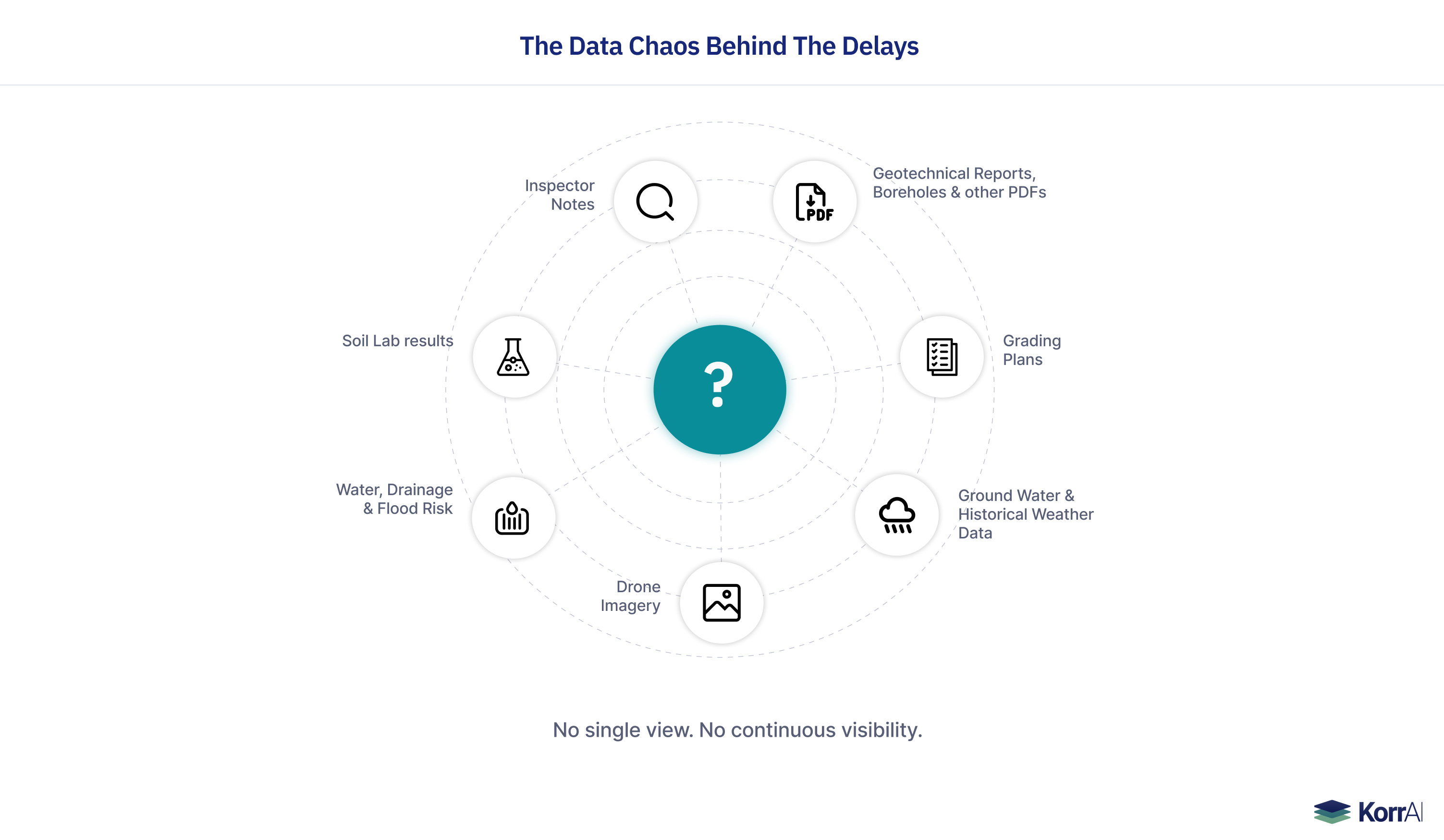
Bien qu'il n'existe aucun historique pluriannuel ni aucune analyse des tendances à grande échelle, chacun de ces ensembles de données est utile en soi. Cependant, ils forment rarement une vue d'ensemble cohérente du comportement du site. L'analyse pluriannuelle des déformations pour l'étude de site et les contrôles de stabilité périodiques peut être facilitée par des capteurs radar satellitaires ou terrestres, mais les fournisseurs traditionnels livrent généralement des données difficiles à interpréter et déconnectées du contexte de construction.
Les ingénieurs en risques et les directeurs de projet passent des heures, voire des jours, à reconstituer l'historique du terrain à partir de réunions, de courriels et de fichiers disparates. Lorsqu'ils obtiennent enfin une réponse, le retard est déjà considérable.
4. La diligence raisonnable manuelle ne peut suivre le rythme et l'ampleur des chantiers
Pour un seul propriétaire d'actifs, plusieurs chantiers peuvent être en développement simultanément. Les équipes de gestion des risques et de géotechnique ne croissent pas au même rythme. Ce déséquilibre force les équipes à sacrifier la profondeur au profit de la rapidité; les demandes d'information (RFI) s'accumulent et les décisions fondées sur le jugement remplacent celles basées sur les données. Plus tard, ces décisions entraînent des refontes qui perturbent l'échéancier.
Les anomalies locales dans le tassement ou le comportement de la nappe phréatique prennent naturellement plus de temps à être détectées, car elles nécessitent le croisement et la corrélation de données provenant de sources multiples. Faute de moyens adéquats, le résultat est inévitable : refontes, défauts structurels et ordres de changement.
L'impact commercial d'une mauvaise vérification des strates et de la nappe phréatique
Où les projets perdent du temps et des marges
- La refonte des pieux et des strates plus profondes impose de nouveaux calculs structurels. Les équipes d'approvisionnement doivent commander à nouveau des matériaux, souvent à un coût majoré, et la remobilisation des équipes et du matériel doit être planifiée.
- Chaque retard repousse les jalons de mise sous tension et de livraison, perturbant les travaux subséquents comme les installations mécaniques et électriques.
Finalement, le projet est confronté à la question délicate : Qui paie pour le retard?
Les projets attendent encore alors que le sol a cessé de bouger
Les plaques de tassement ou les points de levé offrent une visibilité fragmentée de la stabilité. Une plaque peut indiquer que le sol est stabilisé, tandis qu'une autre zone, éloignée de la plaque, continue de s'affaisser sans être détectée.
Sans une visibilité complète, les équipes choisissent la prudence : « Attendons 30 jours de plus. »
Les outils ne sont pas mauvais, ils sont trop limités. Les méthodes manuelles et ponctuelles ne fournissent que des instantanés au lieu d'une couverture complète. Par conséquent, les projets attendent plus longtemps que nécessaire.
Les services existants ne fournissent que des pièces du casse-tête
Les propriétaires d'actifs finissent souvent par assembler ces ensembles de données par eux-mêmes. Ce dont ils ont besoin, c'est d'une plateforme qui intègre les rapports géotechniques, les forages, l'imagerie par drone, les mesures satellitaires, les plans de nivellement et les journaux de chantier en une vue cohérente du comportement du sol tout au long du cycle de vie du projet.
Présentation de TRAIL pour les propriétaires d'actifs
Dans la plupart des projets de construction, la surveillance du sol se ressemble : quelques forages, quelques plaques de tassement et des relevés effectués tous les quelques jours. C'est suffisant pour respecter la conformité, mais insuffisant pour surveiller la stabilité de manière proactive pendant les activités de fondation, de battage de pieux et d'excavation.
La technologie de KorrAI comble cette lacune en fournissant des données continues sur la stabilité du sol tout au long du cycle de vie d'un projet de construction. La plateforme combine l'interférométrie radar par satellite (InSAR), des capteurs GNSS, des modèles d'élévation et une chaîne de traitement éprouvée propulsée par l'IA. Plutôt que de traiter ces éléments comme des outils distincts, TRAIL les intègre dans des flux de travail pratiques et normalisés que les propriétaires d'actifs peuvent utiliser pour prendre des décisions cruciales avant, pendant et après les phases de construction.
Guides d'utilisation TRAIL pour la construction à très grande échelle
Les guides d'utilisation sont des flux d'analyse structurés au sein de TRAIL qui se concentrent sur une catégorie spécifique de risque lié au sol. Chaque guide combine des données de télédétection, des preuves historiques, de la documentation de chantier et une logique d'ingénierie pour répondre aux questions pratiques auxquelles les parties prenantes sont confrontées lors des travaux de terrassement, des fondations et de la construction verticale.
Un guide d'utilisation analyse les informations provenant des forages, de l'imagerie par drone, des plans de nivellement, des données satellitaires, des indicateurs d'eau souterraine, des rapports géotechniques en format PDF et des relevés de chantier, puis les harmonise en une interprétation unique que les équipes peuvent utiliser immédiatement.
Plutôt que de passer d'un ensemble de données à l'autre, les équipes de projet disposent d'un endroit centralisé où les preuves sont reliées et mises à jour à mesure que les conditions évoluent.
{{services-widget}}
Comment TRAIL s'intègre au cycle de vie de la construction à très grande échelle
Pré-développement et sélection du site
Évaluez plusieurs parcelles pour les risques liés au sol.
Identifiez les dangers souterrains avant de conclure des ententes.
Repérez les premiers indicateurs de problèmes liés aux eaux souterraines, au remblai ou aux activités minières.
Diligence raisonnable avant la construction
Croisez les rapports géotechniques avec les preuves recueillies sur l'ensemble du site grâce aux guides d'utilisation.
Validez les concepts de nivellement par rapport au comportement historique du sol.
Identifiez les déclencheurs potentiels de refonte avant que les lots structurels ne soient finalisés.
Terrassement et amélioration des sols
Suivez le tassement au fur et à mesure qu'il se produit.
Détectez les problèmes liés à la mise en place du remblai, au compactage ou à la qualité du matériau de remplissage.
Surveillez la performance de la surcharge et déterminez le moment où le site est prêt pour la suite des travaux.
Construction verticale
Détectez les tassements anormaux sous les dalles ou les fondations.
Identifiez les zones influencées par la poussée hydrostatique.
Confirmez que le comportement des excavations et des tranchées correspond aux attentes de conception.
Livraison et exploitation à long terme
Poursuivez la surveillance durant les premières années d'exploitation
Détectez rapidement le soulèvement, le glissement ou les mouvements causés par l'humidité.
Conservez des preuves pour appuyer les révisions de garantie ou lors de litiges avec les entrepreneurs.
Conclusion : Résoudre l'incertitude souterraine et le chaos en surface
La construction à très grande échelle évolue rapidement aujourd'hui, mais le sol ne suit pas d'échéancier lorsqu'il bouge. La plupart des retards et des refontes de conception découlent d'une visibilité limitée sur le comportement du sous-sol à mesure que les travaux de terrassement progressent et que les charges varient sur le site. Les forages, les relevés, les données satellites, les modèles de terrain et les rapports isolés fournissent des informations importantes, mais il est impossible d'obtenir une vue d'ensemble manuellement, surtout avec le niveau de perfection exigé par ces projets.
TRAIL offre aux propriétaires d'actifs et aux constructeurs ce qui leur manquait : une plateforme de preuves continue, connectée et multicouche qui permet d'éviter la recherche fastidieuse de données et les jugements partiels, tout en agissant comme un collaborateur pour vous aider à prendre des décisions éclairées.
Notre objectif est simple : offrir une connaissance situationnelle complète du sol sous les projets de construction, en signalant l'instabilité bien avant qu'elle ne devienne un problème coûteux de plusieurs millions de dollars.
Communiquez avec notre équipe d'experts pour découvrir comment TRAIL peut renforcer votre prochain projet. Prendre rendez-vous | KorrAI
Share this post


Written By


Rajul Teredesai
Ingénieur Principal en Stratégie Mondiale / Expert Géotechnique, AWS
Rajul dirige l'atténuation des risques géotechniques pour des projets de centres de données à très grande échelle sur six continents chez Amazon Web Services (AWS). Ingénieur professionnel agréé et ingénieur géotechnique certifié avec plus de 23 ans d'expérience, il se spécialise dans la gestion des risques liés aux infrastructures pour des installations commerciales et gouvernementales critiques dans le monde entier.
.png)
Rahul Anand
PDG et cofondateur
Rahul est PDG et cofondateur de KorrAI. Entrepreneur en série, il a déjà bâti des entreprises prospères dans les secteurs de l'Internet grand public et de l'IoT. Il vise maintenant à lutter contre l'affaissement du sol, qui devrait toucher plus de 25 % de la population mondiale au cours des prochaines décennies.
Written By

Team KorrAI


Risque de Mouvement du Sol

Risque d'Eau et de Drainage

Risque de Pieux

Évolution du Site

Intelligence Documentaire

Superpositions Multirisques
Abonnez-vous à notre infolettre
Nous envoyons à l'occasion des courriels contenant des mises à jour, nos derniers blogues et nos lectures préférées sur InSAR et le paysage lent de l'affaissement du sol.
Lu par les meilleurs professionnels sur
.webp)


Oups ! Quelque chose s'est mal passé lors de la soumission du formulaire.
.webp)


.svg)
.svg)
.svg)
2026 KorrAI. Tous droits réservés.
L'IA traçable pour des projets de plusieurs milliards de dollars.
Abonnez-vous à notre infolettre
Nous envoyons à l'occasion des courriels contenant des mises à jour, nos derniers blogues et nos lectures préférées sur InSAR et le paysage lent de l'affaissement du sol.
Lu par les meilleurs professionnels sur
Oups ! Quelque chose s'est mal passé lors de la soumission du formulaire.