
AI for Due Diligence & Monitoring
Data Center Site Selection
Make defensible site-selection and construction decisions, from phase-1 to energization for data centers
Trusted by hyperscale operators and leading geotechnical consultancies for remote due diligence.



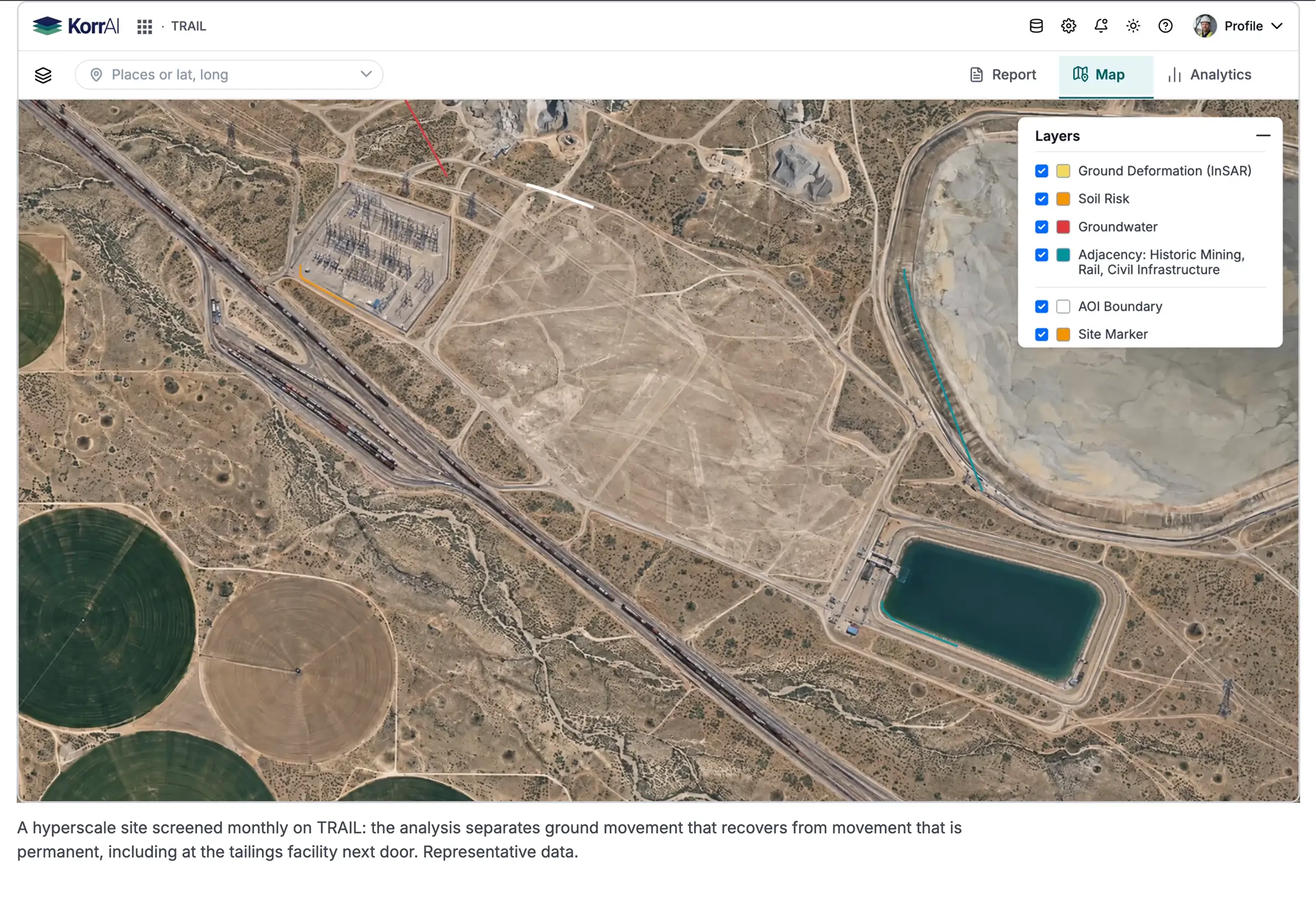
Ready to see TRAIL in action?
.png)
Applications Across the Data Center Lifecycle

Site Selection & Feasibility

Screen karst, subsidence, and groundwater risk before you commit to a site.
Hand your team a provenance-backed baseline before design starts.


Construction Monitoring
Track earthworks and foundation progress against plan, weekly, from satellite.
Verify settlement and stabilization faster than settlement plates.

Builder's Risk & DSU Defense
Price builder's risk on an independent, timestamped record of the site.
Attribute or defend delay claims with an auditable evidence trail.
Problems with building a data center site
Plan Moves Faster than Site Assessment Can.

Boreholes sample points and leave gaps: undocumented fill, groundwater, karst, differential settlement. One surprise can stall the campus.

Bedrock variability and soft-soil settlement cause multi-month delays. Settlement plates confirm stabilization slowly.
.svg)
Delay in startup is a major loss, yet no one holds an independent, timestamped record of what happened on site.

Compressed timelines leave little room for thorough geotechnical study, so risks surface only when they turn costly.
Site-Wide Intelligence, Expert Interpretation
We link and graph multi-source data, anchored by location, that grows as the construction phases progress.
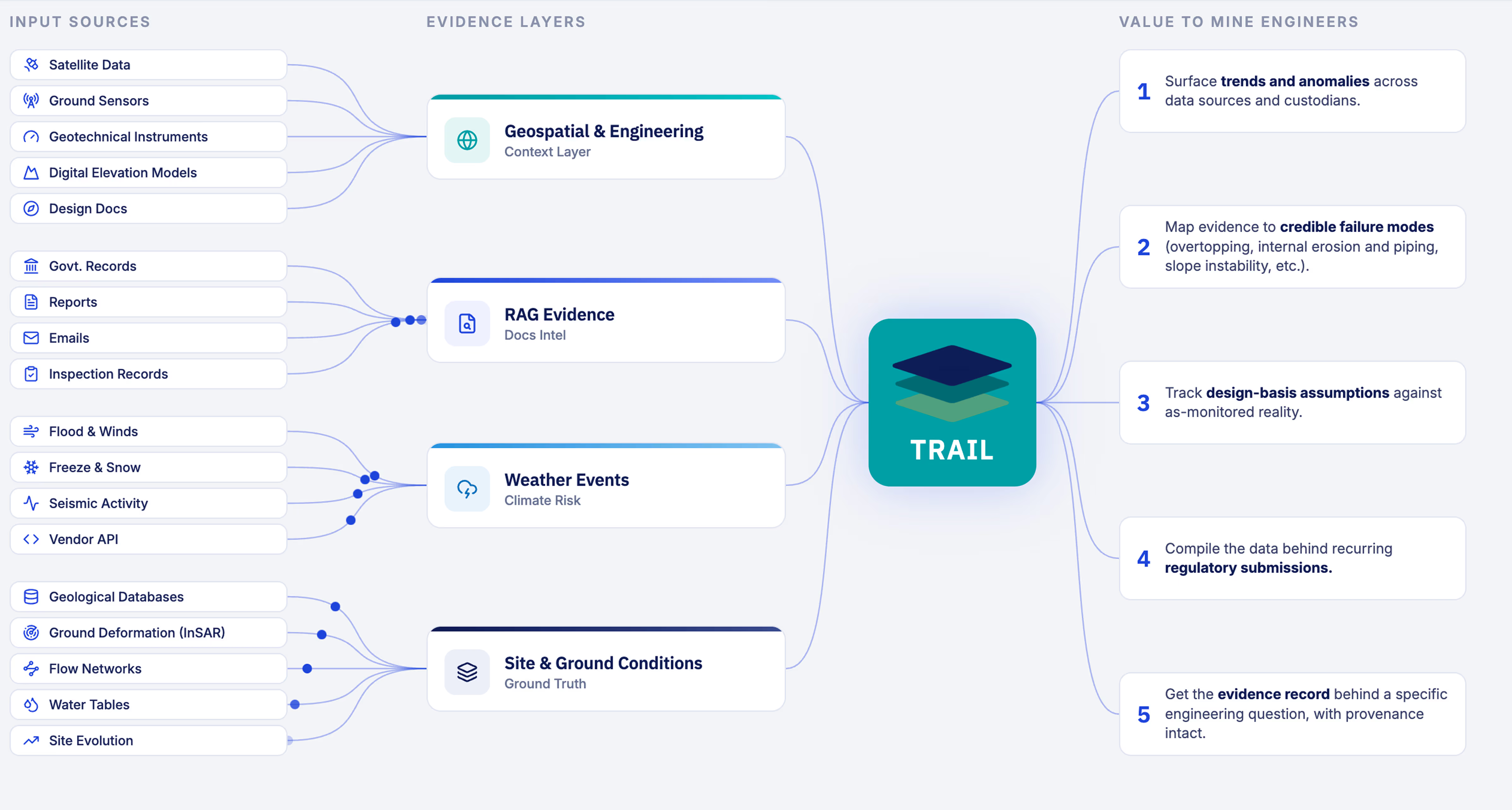
Same Ground, Rising Stakes.
Our Team Analyzes it in Each Phase.
Our specialists assess your site continuously on TRAIL and deliver routine actionable reports, so risk gets resolved before each phase makes it more expensive to act on.
Our team screens parcels against ground motion history, water, geology, hazards, and adjacency before the land is committed.
.webp)
Our delivery team interprets the analysis and ties it to failure modes that pose risk. Construction activity is weighted against the build plan for a dynamic view of risks.
%20(1).webp)
Experts stay in the loop. Evidence stays in TRAIL, timestamped, and cited to sources for diligence, lender confidence, builder’s risk pricing, or delay defense.
.png)
TRAIL Playbooks for Data Center Site Screening
Each playbook is a repeatable analysis TRAIL runs against your site evidence and returns as a cited, reviewable result.
.png)
Karst & Sinkhole Screening
.png)

Flag dissolution features and voids before you commit to the parcel.
Groundwater & Drainage
Map the water table, seepage, and runoff paths before earthworks.
Flood Exposure & Grading
Test site grading against flood and precipitation history.
Seismic & Fault Proximity
Check fault distance and seismic hazard against the planned layout.
Ground Deformation Baseline
Set an InSAR movement baseline the whole build measures against.
Earthworks vs. Plan
Compare cut, fill, and pad progress to schedule from satellite.
Differential Settlement Watch
Track movement across the pad against design tolerance, weekly.
Foundation Stabilization
Confirm settlement has stabilized faster than plate readings alone.
Builder's Risk Evidence Pack
Hand underwriters a timestamped, cited site record at bind.
DSU / Delay Attribution
Reconstruct what happened on site, with provenance, for any claim.
Who Is Involved From Your Team?

Geotech engineers & EoRs
at the operator, GC, or consultancy
.svg)
Risk engineers & underwriters
at insurers and asset owners, pricing and defending builder's risk and DSU.
.svg)
Capital-program leads
at hyperscalers and collocation facilities.
.svg)
Lenders & infrastructure debt funds
needing independent verification of progress.
Screen Your Data Center, Early.
Bring a site you are evaluating, or let us walk you through one we know well.
.png)
CEO and Co-Founder
.png)
CPO and Co-Founder
Frequently Asked Questions
How do you support data center site selection and due diligence?
Our team screens ground risk between boreholes, karst, settlement, and groundwater, and compiles a timestamped, source-linked baseline of the site before you commit. Every finding cites the document, reading, or layer behind it, and you get access to the workspace holding that evidence.
What is a phase-1 assessment for a data center site, and how do you help?
A phase-1 assessment characterizes site conditions before design and construction. We assemble the satellite, geotechnical, and documentary evidence into one reviewable package on TRAIL, so the assessment starts from a complete, traceable picture rather than scattered files.
Do we run TRAIL ourselves, or does your team do the work?
Our specialists run the screening and interpret the results, then deliver a cited report on a weekly or monthly cycle. You also get access to TRAIL with all the underlying evidence, so your team can review findings, ask follow-up questions, and trace any claim back to source.
Can this replace a geotechnical study or the Engineer of Record?
No. We complement boreholes, field investigation, and the EoR. Our team assembles and cites the evidence and supports review. Judgment, design, and sign-off stay with the qualified engineer on record.
Which ground risks matter most for hyperscale data center construction?
Differential settlement, karst and subsidence, groundwater and drainage, and schedule slippage against plan. Our analysts map evidence to each risk mode, rather than reporting movement in isolation.
How do owners and insurers use the same record?
Both work off one independent, timestamped site record. Owners use it to de-risk selection and construction. Insurers use it to price builder’s risk and to attribute or defend delay claims. Because the reporting cycle is continuous, the record is already built when a dispute arrives.
Send us a message
We’ll reach out within 48 hours.
.webp)


.svg)
.svg)
.svg)
Subscribe To Our Newsletter
.webp)